
If you’ve ever searched for condo garage door repair chicago HOA guidelines and landed on confusing results, Schaumburg residents face the same frustrating maze when a garage door breaks and the HOA gets involved. In most Schaumburg condo and HOA communities, the answer to “who handles this?” isn’t obvious, and the wrong move can cost you money or get you a violation notice. Responsibility usually falls on the unit owner for repair costs, but the HOA often controls what contractor you use and what materials get approved. Schaumburg’s mix of townhome associations, condo complexes, and planned communities means the rules vary more than you’d expect from one subdivision to the next. This guide breaks down the legal split, what your declaration actually says, real permit requirements, and a step-by-step workflow you can use today.
Need a licensed contractor who already knows how Schaumburg HOA communities work? Get a free estimate from a local Schaumburg specialist.
Who Is Responsible for Garage Door Repairs in a Schaumburg Condo or HOA?
In Schaumburg HOA and condo communities, responsibility for garage door repair almost always lands on the unit owner, but the HOA retains approval authority. That’s the core tension you’re dealing with. You pay, they approve. It feels backwards, but it’s standard across Illinois condo law.
Under the Illinois Condominium Property Act (765 ILCS 605), garage doors attached to individual units are typically classified as “limited common elements.” That means they serve only your unit, but they’re still part of the common structure. The association doesn’t maintain them, but it does control what happens to them aesthetically and structurally.
For planned unit developments (PUDs) and HOA-governed single-family or townhome communities in Schaumburg, the same general principle applies, though it’s governed by the Declaration of Covenants, Conditions, and Restrictions (CC&Rs) rather than the Condo Act. The declaration is the document that actually determines responsibility in your specific community.
So don’t assume anything based on what your neighbor told you. Pull your declaration and read the definitions section. It’ll tell you whether the garage door is “common element,” “limited common element,” or “unit” property. That classification determines everything.
What Does Your HOA Declaration Actually Say About Garage Doors in Schaumburg?

Your HOA declaration is the governing document that overrides any general assumption about who’s responsible. Most Schaumburg homeowners haven’t read it in full, which is exactly how disputes start.
Look for three things in your declaration. First, find the definitions section and look up how “garage door” is categorized. If it’s listed under “limited common elements,” you’ll typically pay for maintenance and repairs while the HOA governs appearance and approved materials. Second, find the maintenance responsibilities section. Some Schaumburg HOAs split responsibility: they maintain the exterior shell of shared structures but leave the operating components (springs, cables, openers) to the unit owner. Third, check the architectural review or modification section. Even a like-for-like panel replacement may require written approval if it touches the exterior appearance of the building.
In townhome-style communities in Schaumburg, like those in the Weathersfield neighborhood, garage doors are often visible from the street and are explicitly governed by the HOA’s architectural standards. Color, panel style, and window configuration may all be restricted. In attached condo-style communities, the rules tend to be even stricter because a garage door change affects the entire building’s facade.
If you can’t find your declaration, your HOA management company is required to provide it. In Schaumburg, the Village itself doesn’t maintain copies of private CC&Rs, so you’ll need to go through your association directly.
Who Pays for What? A Cost Breakdown for Schaumburg HOA and Condo Repairs
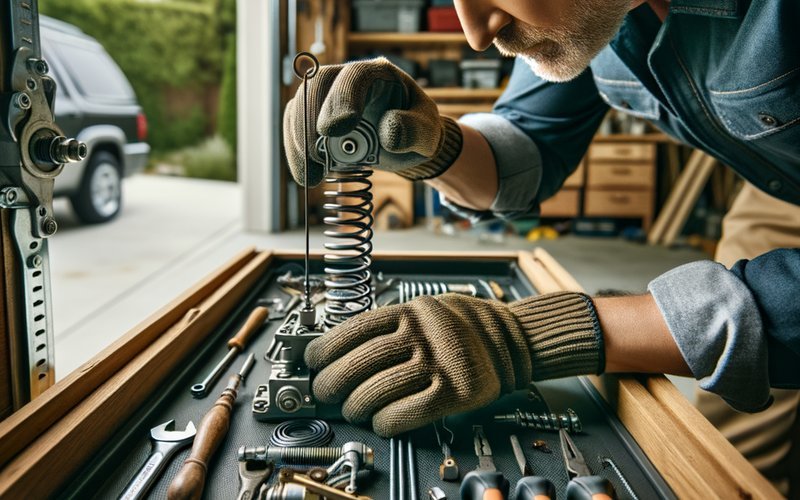
Most repair costs fall to the unit owner in Schaumburg HOA communities, with the HOA covering only damage to true common elements. Here’s how the typical cost split works in practice, with real 2026 price ranges for Schaumburg.
| Repair Type | Who Typically Pays | Estimated Cost (2026) | HOA Approval Usually Required? |
|---|---|---|---|
| Spring replacement (torsion or extension) | Unit owner | $180–$350 | No (non-visible component) |
| Cable repair | Unit owner | $150–$275 | No |
| Panel replacement (one panel) | Unit owner | $250–$600 | Yes (affects exterior appearance) |
| Full door replacement | Unit owner | $900–$2,400 installed | Yes (required in almost all Schaumburg HOAs) |
| Opener replacement | Unit owner | $250–$550 installed | Rarely (internal mechanism) |
| Damage from shared structure failure | HOA (if structure is common element) | Varies by scope | HOA authorizes directly |
| Emergency repair (door off-track, won’t close) | Unit owner | $200–$500 | Notify HOA after if non-structural |
Honestly, the biggest cost surprises happen during full replacements. If your HOA requires a specific door brand or model to match the rest of the building, you won’t be able to shop for the cheapest option. Some Schaumburg communities specify exact door models, and going off-spec means you’ll either pay a fine or have to redo the work.
If you want an accurate quote for your specific situation and community, professional garage door repair chicago contractors who work in Schaumburg HOA communities can assess the job and tell you exactly what the HOA is likely to approve before you commit to anything.
Do You Need HOA Approval Before Scheduling a Repair in Schaumburg?
For most visible repairs in Schaumburg HOA communities, yes, you need written approval before work starts. For internal mechanical repairs, usually not. The line is whether the repair changes anything visible from outside the unit.
A broken spring? Schedule the repair. The spring isn’t visible, doesn’t change the door’s appearance, and most HOA declarations specifically carve out routine maintenance from the approval process. A snapped cable is the same story. These are operational repairs that don’t touch aesthetics.
But if you’re replacing panels, swapping out the full door, or changing the opener system in a way that requires hardware on the door face, you’ll want to submit an Architectural Review Committee (ARC) request first. Most Schaumburg HOAs process ARC requests in 7–21 days. Some larger professionally managed associations respond faster. Plan around that window before you schedule a contractor.
Get the approval in writing. An email confirmation from the property manager counts. If you proceed without written approval and the HOA disputes your door choice, you could be forced to replace it again at your own cost. That’s an expensive lesson that comes up more often than you’d think in Schaumburg’s townhome communities.
Does the Village of Schaumburg Require a Permit for Garage Door Work in an HOA Community?

In Schaumburg, the Village’s Building and Inspections Division (located at Village Hall, 101 Schaumburg Court) requires a permit for full garage door replacements in most cases. Simple mechanical repairs, like spring or cable replacement, do not require a permit.
A like-for-like door replacement on a residential unit typically requires a building permit. The permit fee runs $50–$150 depending on the project scope, and a licensed contractor will pull it on your behalf. You’ll want to confirm the current requirement directly with the Building and Inspections Division, since permit thresholds can change.
For condo buildings with shared parking structures or multi-unit garages, the permit process can be more involved. Structural changes to a common garage building will likely require a full permit, plans review, and a final inspection. Your contractor should know this going in. If they don’t ask about permit requirements for your type of building, that’s a red flag. For more on how permit rules work across the Chicago area, the article on Chicago garage door repair permits is worth a read.
Real Example: A Homeowner in Weathersfield vs. One in Schaumburg Chase
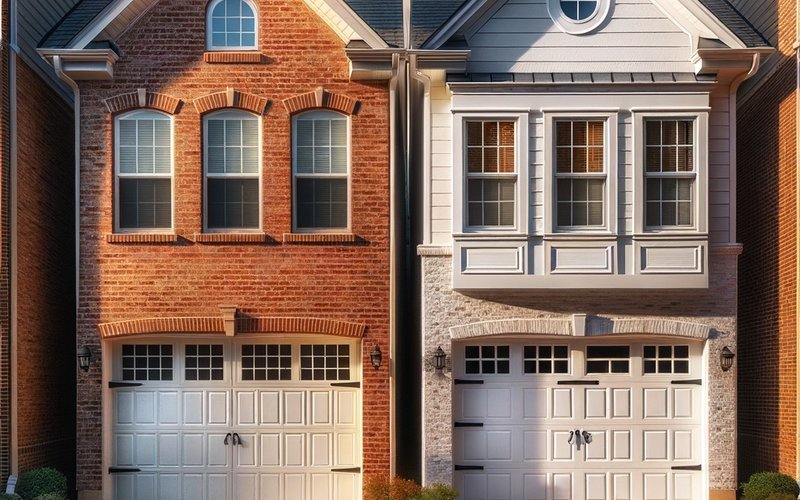
Two real-world scenarios from Schaumburg neighborhoods show just how differently this plays out depending on community type.
Weathersfield Townhome Owner
A homeowner in Weathersfield, a large townhome community in the southeast part of Schaumburg, recently had a bottom panel cracked after a minor backing accident. The door still operated fine. Cost to replace the panel: around $380. But because the door faces the shared drive and is visible from the common area, her HOA required an ARC submission before work could begin. She submitted photos and the contractor’s proposal. Approval came back in 11 days. The replacement matched the existing panel profile exactly, which made approval straightforward. Total time from damage to completed repair: just under three weeks.
Schaumburg Chase Condo Owner
A unit owner in Schaumburg Chase had both torsion springs snap on a Monday morning, leaving the door stuck closed. This was a mechanical repair with no exterior change. He called a contractor the same day. No ARC request was needed. Repair took about 90 minutes and cost $240. He notified the HOA property manager afterward as a courtesy, which is good practice. The whole situation was resolved by noon.
The difference: one repair changed the exterior, one didn’t. That’s the line you need to know before you pick up the phone.
What to Do Right Now If Your Garage Door Broke and You’re in an HOA
Here’s a simple workflow for Schaumburg HOA residents dealing with a broken garage door right now.
- Assess whether it’s a safety emergency. If the door is stuck open, stuck mid-travel, or won’t close at all, that’s an emergency. You can call for same-day repair without waiting for HOA approval. Notify the HOA right after.
- Identify the repair type. Is this mechanical (springs, cables, opener, tracks)? Or does it change the exterior (panels, full door)? Mechanical repairs generally don’t need pre-approval.
- Pull your HOA declaration. If you don’t have it, email your property manager today and request the relevant maintenance and ARC sections.
- Submit an ARC request if needed. Include photos, the contractor’s proposal, and the specific door or panel specs. The more detail you provide, the faster the review goes.
- Get the permit sorted. A licensed contractor will handle this, but confirm they know Schaumburg’s requirements for your building type.
- Schedule and document everything. Keep emails, approvals, and invoices. If there’s ever a dispute, you’ll want the paper trail.
How to Find the Right Garage Door Contractor for HOA Work in Schaumburg
Not every garage door contractor knows how to work within HOA constraints, and in Schaumburg, that knowledge gap causes real problems. You need someone who understands the approval process, can provide the exact specs your ARC committee wants to see, and is licensed to pull permits with the Village’s Building and Inspections Division.
Ask any contractor these questions before you hire them for condo garage door repair in a Schaumburg HOA community:
- Are you licensed and insured in Illinois, and can you pull the permit with the Village of Schaumburg?
- Have you worked in HOA-governed communities in Schaumburg before?
- Can you provide documentation that meets an ARC submission, including material specs and photos of comparable work?
- Do you match existing door profiles for panel replacements, or do you only stock limited options?
- What’s your timeline for emergency work versus scheduled HOA-approved work?
A contractor who hesitates on any of these isn’t ready for HOA work. The right person will answer confidently, because they’ve done it before. Look for someone with verifiable Illinois licensing (you can check contractor license status through the Illinois Department of Financial and Professional Regulation), several years of documented local work, and clear communication about what your HOA will and won’t accept. That combination keeps your repair on track, your HOA happy, and your wallet from taking a second hit on rework.