
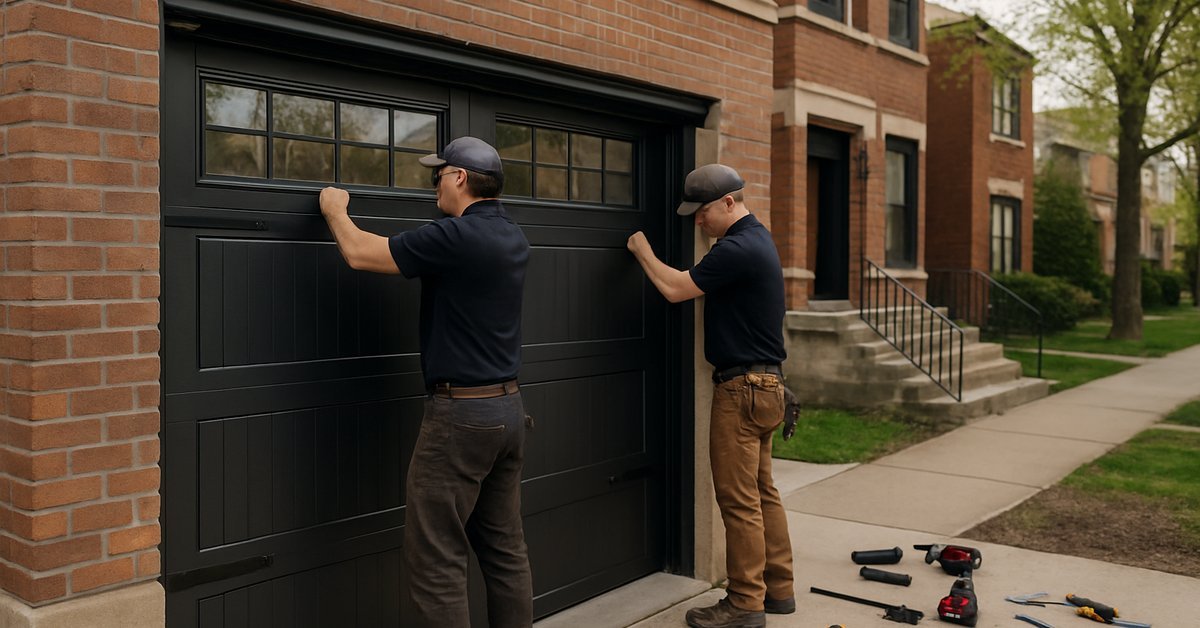
You’re replacing a garage door on Chicago’s North Side and you want a straight answer on cost, permits, and what to actually expect. Here it is: most North Side homeowners pay $1,100–$2,200 for a fully installed steel insulated door, including removal of the old one. Custom wood carriage-house styles common in older neighborhoods push that to $2,500–$4,500. Chicago’s vintage housing stock, alley-access layouts, and brutal winters make this a different project than it is in the suburbs. This guide covers real 2026 cost ranges, permit rules from the City of Chicago Department of Buildings, door type tradeoffs for both vintage and modern garages, and how to hire someone without overpaying. Get a free estimate from a licensed Chicago contractor before you commit to anything.
How Much Does Garage Door Installation Cost on Chicago’s North Side?
In Chicago, garage door installation pricing breaks down into three layers: the door itself, the hardware and spring system, and labor. Labor alone runs $250–$500 for most residential jobs. Don’t let anyone quote you a single number without itemizing these.
| Door Type | Door Cost (material only) | Installed Total (2026) | Best For |
|---|---|---|---|
| Single steel, non-insulated | $300–$550 | $800–$1,100 | Detached alley garages |
| Double steel, insulated (R-12+) | $600–$950 | $1,100–$1,800 | Attached or heated garages |
| Steel with faux wood finish | $800–$1,400 | $1,400–$2,200 | Greystone and vintage homes |
| Real wood carriage-house style | $1,500–$3,500 | $2,500–$4,500 | Lincoln Park, Roscoe Village |
| Full-view aluminum/glass | $1,200–$2,800 | $2,000–$4,000 | Modern infill construction |
A homeowner in Andersonville recently swapped out a 1960s wooden door on their detached two-car alley garage for an insulated double steel door. Total cost: $1,640, which included a new torsion spring system and keypad opener. The job took four hours. That’s a realistic mid-range example for this part of the city.
Your biggest cost variable isn’t the door, it’s the opener and spring system. If the existing opener is more than 12 years old, most installers will recommend replacing it at the same time. A new belt-drive opener adds $250–$450 to the total. Torsion spring replacement, if needed, runs $180–$340. Read more about what spring replacement costs in Chicago so you’re not caught off guard.
So what drives the price up on the North Side specifically? Older garage structures often have non-standard openings that require custom framing. Alley access means parking a service truck in a tight space. And some vintage garages haven’t had new hardware in 30+ years, meaning more surprises once the old door comes off. Budget a 10–15% contingency.
What Type of Garage Door Should North Side Chicago Homeowners Actually Buy?
The right door depends on whether your garage is attached or detached, heated or unheated, and what your building’s style demands. In Chicago’s older neighborhoods, those three factors pull in different directions.
| Factor | Best Door Choice | Why It Matters Here |
|---|---|---|
| Detached, unheated alley garage | Steel, non-insulated or R-6 | No point insulating a space with no heat source |
| Attached garage, conditioned space | Steel insulated, R-12 to R-18 | Heat loss through the door affects your heating bill |
| Historic or greystone building | Faux wood steel or real wood | Curb appeal and sometimes HOA/landmark requirements |
| Modern infill or new construction | Full-view aluminum or flush steel | Matches contemporary architecture |
Honestly, most contractors will push insulated steel on every job because the margins are better. That’s not always wrong. But if your garage has no heat source and sits 40 feet from the house behind an alley, spending an extra $400 on R-18 insulation is money you won’t recover. Ask specifically: is this garage conditioned or will it ever be?
Steel is the dominant material on the North Side for good reason. It holds up against freeze-thaw cycles, it doesn’t warp like wood in humidity, and it’s cheaper to repair. If you want the wood look without the maintenance, faux wood steel panels hit a sweet spot. They’re made by major manufacturers like Clopay and CHI Overhead Doors and honestly look convincing from the street.
Real wood is worth considering if you’re in a landmark district or your home’s character genuinely calls for it. Just know you’re committing to refinishing every 3–5 years in this climate. The freeze-thaw cycle is relentless on painted or stained wood end grain.
Do You Need a Permit for Garage Door Installation in Chicago?

For a standard like-for-like garage door replacement in Chicago, no permit is required from the City of Chicago Department of Buildings. You’re swapping one door for another of the same size and type, and that falls under routine maintenance under Chicago’s building code.
But the rules change in three situations. First, if you’re changing the size of the opening, you need a permit because that involves structural modification. Second, if your home is in a Chicago Landmark District or sits on a Chicago Landmark-designated property, you need approval from the Commission on Chicago Landmarks before any exterior change. Third, if you’re converting a garage from a one-car to a two-car opening, that’s structural work requiring permits and an architect’s sign-off in most cases.
The City of Chicago Department of Buildings handles all residential permits. You can check requirements and submit applications through their online portal. Permits for simple structural garage work typically run $100–$300 and take 2–4 weeks to process. Don’t let a contractor pull a permit and then disappear before the final inspection is done. That leaves the liability with you. For a deeper look at when permits apply, see this guide on Chicago garage door repair and permit requirements.
Which North Side Neighborhoods Have the Trickiest Installation Jobs?
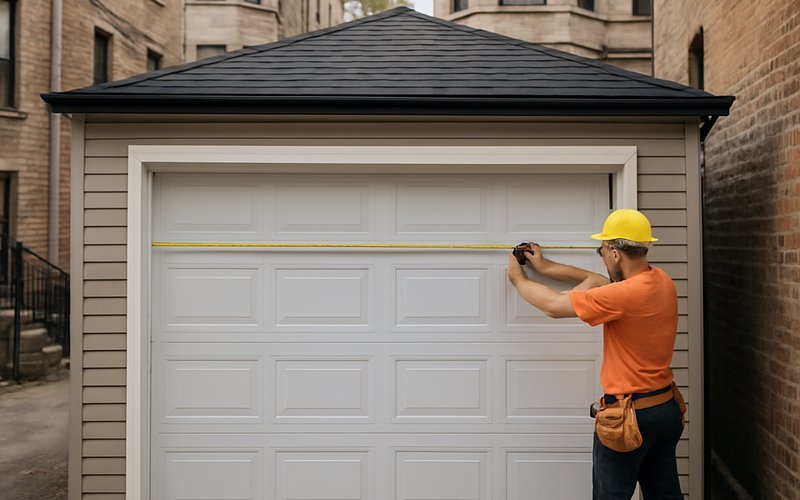
North side Chicago garage door installation isn’t uniform across neighborhoods. The building stock, lot widths, and alley configurations vary block by block, and some areas consistently produce harder jobs.
Lincoln Park and Old Town
These neighborhoods have some of the oldest garage structures in the city. Many are single-car brick carriage houses built in the 1890s–1920s with rough openings that are slightly off-square. Getting a modern door to hang true in a century-old frame takes skill. Installers who don’t measure carefully end up with doors that bind. Expect to pay a 10–15% premium over standard jobs here for the extra framing work.
Roscoe Village and Ravenswood
These are classic bungalow and two-flat neighborhoods with detached alley garages. The alley access is tight, and many garages share a wall with a neighbor’s structure. That limits how installers can position their equipment. It’s not a dealbreaker, but it adds time. A homeowner in Roscoe Village replaced a failing wood door last winter for $1,380 including a new torsion spring and weather stripping. The extra wall-sharing issue added about an hour to the job.
Wicker Park and Bucktown
Heavy gentrification here means newer attached garages mixed in with converted coaches houses. The newer structures are usually easier. But some of the renovated coach houses have custom openings that don’t match standard door widths. You’ll want an installer who measures in person before quoting you anything. And if you’re in a greystone that’s been landmarked, check landmark requirements before ordering your door.
If you’re near the northern edge of the city and want to compare options, it’s worth knowing that neighboring Skokie has its own service infrastructure. Fairway Garage Door offers garage door repair in Skokie with the same team that covers the North Side.
What’s Included in a Professional Garage Door Installation in Chicago?
A legitimate installation job isn’t just dropping a new door into an opening. Here’s what you should expect from a professional North Side installer, and what should be included in the quoted price without upselling.
- Removal and disposal of the old door including panels, hardware, and tracks
- Installation of new tracks, rollers, and mounting hardware sized to the new door
- Spring system setup, either torsion (above the door) or extension (along the sides), correctly tensioned for the door weight
- Opener integration if you’re keeping the existing opener, or full opener installation if replacing
- Safety sensor alignment and testing, required by federal law on all door openers made after 1993
- Weather stripping installation on the bottom seal and sides
- Full operational test including manual release, auto-reverse test, and balance check
Ask specifically if disposal is included. Some low-quote contractors leave the old door in your alley and expect you to handle it. That’s a problem in Chicago, where the city can ticket you for bulk dumping in alleys. Disposal should be in the quote or explicitly listed as separate.
If you want an accurate quote for your specific setup, reach out to Fairway Garage Door for a no-pressure estimate on your Chicago installation.
Custom vs. Standard Garage Doors: Which Is Right for Your Chicago Home?
Standard doors fit openings between 8–18 feet wide and 7–8 feet tall. Most garages on Chicago’s North Side fall within those dimensions. If yours does, a standard door is almost always the smarter buy. Lead times are shorter (usually 1–3 weeks), costs are lower, and warranty replacement parts are easier to get.
Custom doors make sense in three situations. First, non-standard opening sizes, which are common in pre-war coach houses and carriage houses. Second, landmark or historic homes where the door design has to match a specific era or style. Third, high-end renovations where the door is a design statement and budget isn’t the primary concern.
Custom doors from manufacturers like Wayne Dalton or Clopay typically take 4–8 weeks to fabricate. During that window, you need either a temporary solution or to plan around the timeline. Don’t order a custom door in November if your garage is your primary access point and Chicago winter is bearing down.
The cheaper option isn’t always wrong here. A well-installed, insulated steel door from a quality manufacturer like Amarr or CHI will outperform a poorly maintained custom wood door every single winter. Maintenance matters more than material in Chicago’s climate. See the seasonal maintenance tips for Chicago homes to keep any door performing long-term.
How to Choose the Right Garage Door Installer on Chicago’s North Side

Before you hire anyone for north side Chicago garage door installation, ask four specific questions. They’ll separate real contractors from fly-by-night operations fast.
- Are you licensed in Illinois? Illinois requires a general contractor license for structural work. For door installation specifically, look for a state license and proof of liability insurance (minimum $1 million coverage).
- Do you install the manufacturer’s brand you’re quoting, or a gray-market equivalent? Some contractors quote name-brand doors and install cheaper substitutes. Ask to see the manufacturer’s invoice or warranty card at job completion.
- Who does the actual installation? Some companies quote the job and then send a subcontractor you’ve never met. That’s not automatically bad, but you deserve to know in advance.
- What’s your warranty on labor? Parts warranties come from the manufacturer (usually 1–10 years depending on component). Labor warranties vary widely. One year minimum is a baseline; two years is better.
Get at least two written quotes. One quote tells you nothing. Two quotes reveal whether the first number was realistic. If one quote is 40% below the other, ask why specifically. It’s usually a difference in spring system quality, hardware grade, or what’s included in disposal and cleanup.
Avoid any installer who can’t give you a written quote with line items, won’t pull a permit when one is genuinely required, or pushes you to pay the full amount upfront. A deposit of 30–50% is normal. Full payment before the job is done is a red flag. Check Google reviews specifically for the North Side or your neighborhood, and prioritize installers who’ve worked on alley garages or vintage structures in Chicago if that’s your situation. For a broader look at how to find a trustworthy garage door company in Chicago without getting overcharged, that guide covers the vetting process in more detail.
Ready to move forward? Fairway Garage Door installs and services garage doors across Chicago’s North Side, with real experience in the vintage and alley-access garages that make this part of the city different. Contact us for a free, itemized installation quote and we’ll tell you exactly what your job will cost before we touch anything.